60-night guarantee · Finish the box and still get your money back

60-night guarantee · Finish the box and still get your money back
Wide awake at 11pm? Read this first.
The reason you're flat at 3pm and sharp at 11pm has nothing to do with your sleep habits.
You've already fixed the room, the screens, the caffeine cut-off. You've got a shelf of half-finished bottles that each worked for about a fortnight. None of it touched the 3am wake — because none of it was aimed at what's actually causing it.
Built around the rhythm problem behind the 3am wake — not the symptom
Contains the one overnight variable missing from every sleep shelf in Britain
Forty seconds a night. No pills, no melatonin, nothing to sleep off at seven
Informed Sport certified. Every batch third-party tested. Every dose on the label
★★★★★ 4.7 from 2,400+ verified reviews
Wide awake at 11pm? Read this first.
The reason you're flat at 3pm and sharp at 11pm has nothing to do with your sleep habits.
You've already fixed the room, the screens, the caffeine cut-off. You've got a shelf of half-finished bottles that each worked for about a fortnight. None of it touched the 3am wake — because none of it was aimed at what's actually causing it.
Built around the rhythm problem behind the 3am wake — not the symptom
Contains the one overnight variable missing from every sleep shelf in Britain
Forty seconds a night. No pills, no melatonin, nothing to sleep off at seven
Informed Sport certified. Every batch third-party tested. Every dose on the label
★★★★★ 4.7 from 2,400+ verified reviews
You're not bad at sleeping. You've been sleeping badly at the wrong end of the night.
Three in the afternoon and you've read the same paragraph four times. You get through the meeting on autopilot.
Somebody asks a question and you hear yourself answering from somewhere slightly behind your own head.
Then somewhere after nine, it lifts.
By eleven you're the sharpest you've been all day. So you use it — because it's the only clear window you get — and you go up at half twelve knowing exactly what happens next.
3:47am. Not drifting awake. Snapped awake, with the brain already at full speed, running tomorrow's list in an order you did not choose. Ninety minutes of ceiling. Then twenty minutes of proper sleep just before the alarm, which is somehow worse than none.
And the part nobody says out loud: you've stopped mentioning it. Because the advice is always the same — have you tried a cooler room, have you tried magnesium, have you tried putting your phone downstairs — and you've done all of it. Twice. You've kept a spreadsheet.
It happened on holiday too. Stressor removed, nothing to be anxious about, and you still snapped awake at four in a hotel in Portugal. That's the detail that tells you this isn't in your head.
Here's what's actually happening
Your problem was never falling asleep. It's a timing fault in a hormone that's supposed to be at its lowest when you go to bed — and a second, quieter deficit that has been compounding every single night you've slept through it.
You're not bad at sleeping. You've been sleeping badly at the wrong end of the night.
Three in the afternoon and you've read the same paragraph four times. You get through the meeting on autopilot.
Somebody asks a question and you hear yourself answering from somewhere slightly behind your own head.
Then somewhere after nine, it lifts.
By eleven you're the sharpest you've been all day. So you use it — because it's the only clear window you get — and you go up at half twelve knowing exactly what happens next.
3:47am. Not drifting awake. Snapped awake, with the brain already at full speed, running tomorrow's list in an order you did not choose. Ninety minutes of ceiling. Then twenty minutes of proper sleep just before the alarm, which is somehow worse than none.
And the part nobody says out loud: you've stopped mentioning it. Because the advice is always the same — have you tried a cooler room, have you tried magnesium, have you tried putting your phone downstairs — and you've done all of it. Twice. You've kept a spreadsheet.
It happened on holiday too. Stressor removed, nothing to be anxious about, and you still snapped awake at four in a hotel in Portugal. That's the detail that tells you this isn't in your head.
Here's what's actually happening
Your problem was never falling asleep. It's a timing fault in a hormone that's supposed to be at its lowest when you go to bed — and a second, quieter deficit that has been compounding every single night you've slept through it.
The mechanism
Meet the Inverted Curve.
Cortisol is not the enemy. Cortisol is a clock.
In a normally-timed adult it spikes hard within about half an hour of waking — that's the surge that gets you upright — and then falls steadily all day, hitting its floor around the time you go to bed. Sharp at eight in the morning. Flat at eleven at night. That's the shape it's meant to make.
Under sustained load, that curve arrives late.
The morning surge blunts. The evening fall doesn't happen on schedule. And you end up living the exact inversion of the pattern your body was built for — flat when you need to think, climbing when you need to stop.
Which is why the 3pm crash and the 11pm second wind are not two separate problems you happen to have at once. They are two ends of one line, read at two different hours.
And it doesn't stop at bedtime
An average adult loses between 16 and 32 ounces of fluid across a single night. Not just water — sodium, potassium and magnesium go out with it, into the sheets and the air.
So the 3am wake is happening to a body that is already running short. And if you've been cutting liquids before bed to stop the trips to the bathroom — which almost everyone with a maintenance-waking problem eventually does — you have been going to bed depleted on purpose, every night, for years.
16–32oz
Fluid lost across one night
3
Minerals that leave with it
0
Sleep products on the shelf that replace them
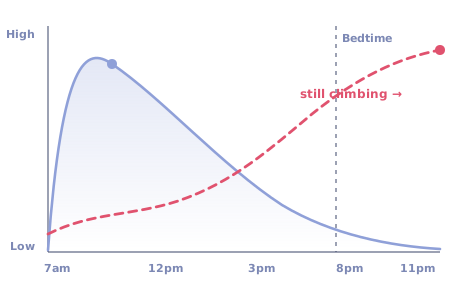
Illustrative shape of a daily rhythm. Not measured values, not a depiction of any individual.
What the Inverted Curve costs you, night after night
You fall asleep fine, then surface between three and four — every night, for months or years
The wake isn't gradual. You snap awake with the brain already running, which is the tell that it's physiological rather than psychological
You go to bed already short on fluid and minerals, and short again the next night, and the next
Every fix you try works for roughly a fortnight, then quietly stops — so you've stopped believing anything will hold
The afternoons get flatter, the evenings get sharper, and the gap between the two widens
The mechanism
Meet the Inverted Curve.
Cortisol is not the enemy. Cortisol is a clock.
In a normally-timed adult it spikes hard within about half an hour of waking — that's the surge that gets you upright — and then falls steadily all day, hitting its floor around the time you go to bed. Sharp at eight in the morning. Flat at eleven at night. That's the shape it's meant to make.
Under sustained load, that curve arrives late.
The morning surge blunts. The evening fall doesn't happen on schedule. And you end up living the exact inversion of the pattern your body was built for — flat when you need to think, climbing when you need to stop.
Which is why the 3pm crash and the 11pm second wind are not two separate problems you happen to have at once. They are two ends of one line, read at two different hours.
And it doesn't stop at bedtime
An average adult loses between 16 and 32 ounces of fluid across a single night. Not just water — sodium, potassium and magnesium go out with it, into the sheets and the air.
So the 3am wake is happening to a body that is already running short. And if you've been cutting liquids before bed to stop the trips to the bathroom — which almost everyone with a maintenance-waking problem eventually does — you have been going to bed depleted on purpose, every night, for years.
16–32oz
Fluid lost across one night
3
Minerals that leave with it
0
Sleep products on the shelf that replace them
Illustrative shape of a daily rhythm. Not measured values, not a depiction of any individual.
What the Inverted Curve costs you, night after night
You fall asleep fine, then surface between three and four — every night, for months or years
The wake isn't gradual. You snap awake with the brain already running, which is the tell that it's physiological rather than psychological
You go to bed already short on fluid and minerals, and short again the next night, and the next
Every fix you try works for roughly a fortnight, then quietly stops — so you've stopped believing anything will hold
The afternoons get flatter, the evenings get sharper, and the gap between the two widens
Why every single thing on that shelf failed — and it's the same reason each time.
Take an honest look at what's in the drawer. Melatonin. Magnesium glycinate. Ashwagandha. Theanine. 5-HTP. Maybe an antihistamine on the worst weeks. Possibly a gummy.
Different molecules. Different price points. Different promises on the front of each box.
And every one of them is doing the same single job: making you drowsy.
That's the shared flaw. The entire sleep category — from the £4 supermarket tablet to the £60 subscription nootropic — is built on sedation. Get the person unconscious faster. That is the mechanism, and it is the only mechanism most of the shelf has.
The problem
Drowsiness was never your problem. You fall asleep fine. You have never had trouble falling asleep.
You have been treating a timing fault with anaesthetic. And you have been doing it while going to bed short on the minerals your nervous system needs to wind down in the first place.
Melatonin? It's a clock signal. It tells the body what hour it is. It has nothing whatsoever to say to a stress hormone that's still climbing at eleven — which is why you worked out it wasn't working long before anyone admitted it to you. And it hands you a morning you have to shake off.
Magnesium on its own? Genuinely useful. It's why it was your first real win. It also has a ceiling, and you found it in about a fortnight.
Ashwagandha on its own? Same story. Worked briefly, then stopped, and you assumed you'd built a tolerance.
Antihistamines? Sedation with a hangover attached. You already know this one.
You did not fail at any of these. You have been rigorous — more rigorous than most people who work in this industry. The category failed you, because it has been solving for the ten minutes before you fall asleep and ignoring the seven hours after.
Why every single thing on that shelf failed — and it's the same reason each time.
Take an honest look at what's in the drawer. Melatonin. Magnesium glycinate. Ashwagandha. Theanine. 5-HTP. Maybe an antihistamine on the worst weeks. Possibly a gummy.
Different molecules. Different price points. Different promises on the front of each box.
And every one of them is doing the same single job: making you drowsy.
That's the shared flaw. The entire sleep category — from the £4 supermarket tablet to the £60 subscription nootropic — is built on sedation. Get the person unconscious faster. That is the mechanism, and it is the only mechanism most of the shelf has.
The problem
Drowsiness was never your problem. You fall asleep fine. You have never had trouble falling asleep.
You have been treating a timing fault with anaesthetic. And you have been doing it while going to bed short on the minerals your nervous system needs to wind down in the first place.
Melatonin? It's a clock signal. It tells the body what hour it is. It has nothing whatsoever to say to a stress hormone that's still climbing at eleven — which is why you worked out it wasn't working long before anyone admitted it to you. And it hands you a morning you have to shake off.
Magnesium on its own? Genuinely useful. It's why it was your first real win. It also has a ceiling, and you found it in about a fortnight.
Ashwagandha on its own? Same story. Worked briefly, then stopped, and you assumed you'd built a tolerance.
Antihistamines? Sedation with a hangover attached. You already know this one.
You did not fail at any of these. You have been rigorous — more rigorous than most people who work in this industry. The category failed you, because it has been solving for the ten minutes before you fall asleep and ignoring the seven hours after.
Why waiting is the expensive option
Rhythms don't correct themselves. They entrench.
Here's the uncomfortable arithmetic. A mistimed curve is a habit your body is learning. Every night you sleep through the pattern, you rehearse it. Every night you go to bed short on fluid and minerals, the deficit carries into the next one.
Nobody wakes up one morning and finds it has resolved on its own. What actually happens is slower and more expensive:
The 3am wake goes from an occasional annoyance to a fixture you plan around
The afternoon flatness stops feeling like tiredness and starts feeling like who you are now
You quietly reorganise your working life around the eleven o'clock window, which deepens the inversion
You stop testing new variables, because you've been let down eleven times and the twelfth isn't worth the hope
That last one is the real cost. Not the sleep. The point at which you decide this is simply how you are wired now, and stop looking.
Why waiting is the expensive option
Rhythms don't correct themselves. They entrench.
Here's the uncomfortable arithmetic. A mistimed curve is a habit your body is learning. Every night you sleep through the pattern, you rehearse it. Every night you go to bed short on fluid and minerals, the deficit carries into the next one.
Nobody wakes up one morning and finds it has resolved on its own. What actually happens is slower and more expensive:
The 3am wake goes from an occasional annoyance to a fixture you plan around
The afternoon flatness stops feeling like tiredness and starts feeling like who you are now
You quietly reorganise your working life around the eleven o'clock window, which deepens the inversion
You stop testing new variables, because you've been let down eleven times and the twelfth isn't worth the hope
That last one is the real cost. Not the sleep. The point at which you decide this is simply how you are wired now, and stop looking.
The variable nobody sells
Retention Loading: the reason a glass of water at bedtime does nothing, and a loaded one doesn't.
Start with the thing that makes fluid restriction look like it works.
Plain water passes straight through you. Without the minerals that hold it in circulation, most of a bedtime glass is on its way to your bladder within the hour. Which is precisely why cutting it appeared to help — you removed the trips without changing anything underneath, and paid for it by going to bed emptier.
Now load the same glass with sodium, potassium and magnesium in the right ratio, at the right dose, at the right time.
It's retained instead of flushed. The fluid stays where it's useful for the hours it's needed, rather than waking you up asking to leave. That's Retention Loading, and it is the single variable missing from every sleep product you have ever tried — because the sleep category has never thought of itself as a hydration category, and the hydration category dosed everything for training at two in the afternoon.
Put Retention Loading underneath a full-dose wind-down complex and you get the only formula built for both halves of the problem at once: the timing, and the deficit.
100/100/50
mg sodium, potassium and marine magnesium — dosed for overnight retention, not daytime replacement
7
Sleep ingredients at full doses, every milligram printed on the label
0
Melatonin, caffeine, sugar, artificial colours or flavours
The variable nobody sells
Retention Loading: the reason a glass of water at bedtime does nothing, and a loaded one doesn't.
Start with the thing that makes fluid restriction look like it works.
Plain water passes straight through you. Without the minerals that hold it in circulation, most of a bedtime glass is on its way to your bladder within the hour. Which is precisely why cutting it appeared to help — you removed the trips without changing anything underneath, and paid for it by going to bed emptier.
Now load the same glass with sodium, potassium and magnesium in the right ratio, at the right dose, at the right time.
It's retained instead of flushed. The fluid stays where it's useful for the hours it's needed, rather than waking you up asking to leave. That's Retention Loading, and it is the single variable missing from every sleep product you have ever tried — because the sleep category has never thought of itself as a hydration category, and the hydration category dosed everything for training at two in the afternoon.
Put Retention Loading underneath a full-dose wind-down complex and you get the only formula built for both halves of the problem at once: the timing, and the deficit.
100/100/50
mg sodium, potassium and marine magnesium — dosed for overnight retention, not daytime replacement
7
Sleep ingredients at full doses, every milligram printed on the label
0
Melatonin, caffeine, sugar, artificial colours or flavours
Built on it
Cadence Sleep Hydration
One sachet. 350ml of water. Sixty minutes before bed. It is, deliberately, the least interesting part of your evening — and the first thing you've tried that was built for the second half of the night rather than the first ten minutes.

Free cap and variety pack included · Cancel any time · 60-night guarantee
Built on it
Cadence Sleep Hydration
One sachet. 350ml of water. Sixty minutes before bed. It is, deliberately, the least interesting part of your evening — and the first thing you've tried that was built for the second half of the night rather than the first ten minutes.
Free cap and variety pack included · Cancel any time · 60-night guarantee
Three things it does that nothing on your shelf does together.
Pillar 01
The Retention Layer
100mg sodium, 100mg potassium and 50mg marine magnesium — a fraction of a training dose, on purpose. This is not a workout sachet and isn't built like one. It's the smallest quantity that holds fluid through the night without asking you to get up, replacing what those 16 to 32 ounces take with them.
If you've spent years cutting liquids before bed, this is the section that changes the arithmetic. You don't have to choose between hydration and an uninterrupted night any more. That was always a false choice caused by drinking the wrong thing.
Pillar 02
The Thermal Drop
1000mg of L-glycine. A full gram, not a gesture. Glycine helps lower core body temperature — which is one of the body's own pre-sleep signals, the same drop that happens naturally when a properly-timed rhythm is doing its job.
This matters specifically for the Inverted Curve, because a late curve is a curve that isn't sending that signal on time. You're not being sedated into sleep. You're being handed the cue your own system is late delivering.
Pillar 03
The Full-Dose Complex
1000mg L-tryptophan. 200mg L-theanine, which increases alpha brain wave activity — the relaxed-but-alert state, not sedation. 100mg ashwagandha. 75mg valerian root at a concentrated 10:1 extract. 14mg B6. 2mg zinc bisglycinate.
No proprietary blend. No "contains a botanical complex" with the amounts hidden. Every milligram is on the label because you are going to compare it to what's on your shelf — and three of these are almost certainly already there, at doses you'll find are lower than these.
The honest bit
There's no new molecule here and we're not going to pretend there is. Magnesium, theanine and ashwagandha are on your shelf already. What isn't on your shelf is all seven at full dose, sitting on a retention layer, taken as one thing at the same time every night. The combination is the product. Claiming otherwise to someone who reads labels for sport would be the fastest way to lose you.
Free cap and variety pack included · Cancel any time · 60-night guarantee
Three things it does that nothing on your shelf does together.
Pillar 01
The Retention Layer
100mg sodium, 100mg potassium and 50mg marine magnesium — a fraction of a training dose, on purpose. This is not a workout sachet and isn't built like one. It's the smallest quantity that holds fluid through the night without asking you to get up, replacing what those 16 to 32 ounces take with them.
If you've spent years cutting liquids before bed, this is the section that changes the arithmetic. You don't have to choose between hydration and an uninterrupted night any more. That was always a false choice caused by drinking the wrong thing.
Pillar 02
The Thermal Drop
1000mg of L-glycine. A full gram, not a gesture. Glycine helps lower core body temperature — which is one of the body's own pre-sleep signals, the same drop that happens naturally when a properly-timed rhythm is doing its job.
This matters specifically for the Inverted Curve, because a late curve is a curve that isn't sending that signal on time. You're not being sedated into sleep. You're being handed the cue your own system is late delivering.
Pillar 03
The Full-Dose Complex
1000mg L-tryptophan. 200mg L-theanine, which increases alpha brain wave activity — the relaxed-but-alert state, not sedation. 100mg ashwagandha. 75mg valerian root at a concentrated 10:1 extract. 14mg B6. 2mg zinc bisglycinate.
No proprietary blend. No "contains a botanical complex" with the amounts hidden. Every milligram is on the label because you are going to compare it to what's on your shelf — and three of these are almost certainly already there, at doses you'll find are lower than these.
The honest bit
There's no new molecule here and we're not going to pretend there is. Magnesium, theanine and ashwagandha are on your shelf already. What isn't on your shelf is all seven at full dose, sitting on a retention layer, taken as one thing at the same time every night. The combination is the product. Claiming otherwise to someone who reads labels for sport would be the fastest way to lose you.
Free cap and variety pack included · Cancel any time · 60-night guarantee
Forty seconds. Then you go to bed.
You have abandoned a routine before. Everyone reading this has. So here is exactly what it costs, in seconds, before you commit to anything.
01
Tear and pour into 350ml of water
A small glass, not a pint. Cherry. It tastes like a drink rather than a supplement, which is the only reason anyone sticks with one of these.
02
Drink it about an hour before bed
Same time each night. Consistency does more work here than the exact hour does.
03
Go to bed. Change nothing else.
Don't add a new routine on top of it. If you change six variables you won't know which one moved.
04
Judge it at two weeks. Then judge it again at four.
Week four is the one that matters. You've watched three separate things work for a fortnight and then fail. If this is still working at week four, that's the actual signal — and it's a stronger one than week-one enthusiasm ever was.
What to expect, in order
Getting back down faster after the wake, first. Then fewer nights fully alert. Then the eleven o'clock second wind softening. The flat afternoons are last, not first — and anyone selling you that order in reverse has never run it.
What we won't tell you: that you'll stop waking at three. Nobody can honestly promise that. The realistic version is the gap between waking and getting back to sleep going from two hours to fifteen minutes — and if you've lived the two hours, you know exactly how much that's worth.
Forty seconds. Then you go to bed.
You have abandoned a routine before. Everyone reading this has. So here is exactly what it costs, in seconds, before you commit to anything.
01
Tear and pour into 350ml of water
A small glass, not a pint. Cherry. It tastes like a drink rather than a supplement, which is the only reason anyone sticks with one of these.
02
Drink it about an hour before bed
Same time each night. Consistency does more work here than the exact hour does.
03
Go to bed. Change nothing else.
Don't add a new routine on top of it. If you change six variables you won't know which one moved.
04
Judge it at two weeks. Then judge it again at four.
Week four is the one that matters. You've watched three separate things work for a fortnight and then fail. If this is still working at week four, that's the actual signal — and it's a stronger one than week-one enthusiasm ever was.
What to expect, in order
Getting back down faster after the wake, first. Then fewer nights fully alert. Then the eleven o'clock second wind softening. The flat afternoons are last, not first — and anyone selling you that order in reverse has never run it.
What we won't tell you: that you'll stop waking at three. Nobody can honestly promise that. The realistic version is the gap between waking and getting back to sleep going from two hours to fifteen minutes — and if you've lived the two hours, you know exactly how much that's worth.
Everything, in one place.
★★★★★ 4.9 from 2,400+ verified reviews
Retention Loading — 100mg sodium, 100mg potassium, 50mg marine magnesium, dosed to be held overnight rather than flushed
Seven sleep ingredients at full dose — 1000mg tryptophan, 1000mg glycine, 200mg theanine, ashwagandha, valerian 10:1, B6, zinc
Every milligram printed — no proprietary blends, nothing hidden behind a complex
No melatonin — nothing to shake off at seven in the morning
Zero sugar, zero caffeine, no artificial colours, flavours or preservatives
Informed Sport certified, GMP manufactured, third-party tested every batch
60-night guarantee. Use all thirty sachets and still get your money back


Free cap and variety pack included · Cancel any time · 60-night guarantee
Everything, in one place.
★★★★★ 4.9 from 2,400+ verified reviews
Retention Loading — 100mg sodium, 100mg potassium, 50mg marine magnesium, dosed to be held overnight rather than flushed
Seven sleep ingredients at full dose — 1000mg tryptophan, 1000mg glycine, 200mg theanine, ashwagandha, valerian 10:1, B6, zinc
Every milligram printed — no proprietary blends, nothing hidden behind a complex
No melatonin — nothing to shake off at seven in the morning
Zero sugar, zero caffeine, no artificial colours, flavours or preservatives
Informed Sport certified, GMP manufactured, third-party tested every batch
60-night guarantee. Use all thirty sachets and still get your money back
Free cap and variety pack included · Cancel any time · 60-night guarantee
You don't have to decide tonight
60-day guarantee. Empty box still counts.
Two weeks to know if anything's happening. Four to know it isn't another fortnight wonder. We made the window sixty days precisely so there is no version of a fair trial that runs out of time — because a thirty-day guarantee quietly punishes anyone who tests something properly.
Use all thirty sachets. If your mornings haven't changed, email us and we'll refund it. No return shipping. No form. Nobody asking you to justify it.
We can afford to write that because of what happens at week four. The people who make it that far don't ask for refunds — and the ones who do have told us something we needed to know.
You don't have to decide tonight
60-day guarantee. Empty box still counts.
Two weeks to know if anything's happening. Four to know it isn't another fortnight wonder. We made the window sixty days precisely so there is no version of a fair trial that runs out of time — because a thirty-day guarantee quietly punishes anyone who tests something properly.
Use all thirty sachets. If your mornings haven't changed, email us and we'll refund it. No return shipping. No form. Nobody asking you to justify it.
We can afford to write that because of what happens at week four. The people who make it that far don't ask for refunds — and the ones who do have told us something we needed to know.
Give tomorrow a better starting point.
One sachet, an hour before bed, for a month.
Free cap and variety pack · Cancel any time · 60-night money-back guarantee
Give tomorrow a better starting point.
One sachet, an hour before bed, for a month.
Free cap and variety pack · Cancel any time · 60-night money-back guarantee
4.7
Average rating from 2,400+ verified reviews
60
Nights to try it, opened box accepted
100%
Of batches third-party tested by Informed Sport
4.7
Average rating from 2,400+ verified reviews
60
Nights to try it, opened box accepted
100%
Of batches third-party tested by Informed Sport
Food supplement. Not a substitute for a varied, balanced diet or a healthy lifestyle. Not intended to diagnose, treat, cure or prevent any disease. Individual results vary.
On cortisol specifically: cortisol follows a daily rhythm, and that rhythm can shift under sustained stress. This product supports the wind-down and replaces fluid and minerals lost overnight. It is not claimed to lower cortisol, and you should treat any sleep product that makes that claim with suspicion. If night waking has persisted for months, speak to your GP — persistent sleep-maintenance problems can indicate sleep apnea and are worth ruling out properly.
Food supplement. Not a substitute for a varied, balanced diet or a healthy lifestyle. Not intended to diagnose, treat, cure or prevent any disease. Individual results vary.
On cortisol specifically: cortisol follows a daily rhythm, and that rhythm can shift under sustained stress. This product supports the wind-down and replaces fluid and minerals lost overnight. It is not claimed to lower cortisol, and you should treat any sleep product that makes that claim with suspicion. If night waking has persisted for months, speak to your GP — persistent sleep-maintenance problems can indicate sleep apnea and are worth ruling out properly.