60-night guarantee · Finish the box and still get your money back
60-night guarantee · Finish the box and still get your money back

Awake at 3am again?
Stop waking at 3am — in about four weeks, without anything that knocks you out.
The 3am wake-up isn't insomnia and it isn't age. It's a hormone doing exactly what it's designed to do, at exactly the wrong hour — because something is setting it off. Here's what, and how to stop it.
Works on what triggers the 3am spike — not on making you drowsy
Eleven ingredients, every dose printed. Informed Sport certified, tested every batch
Forty seconds a night. One glass of water, an hour before bed
Builds across four weeks and keeps building — no two-week cliff
★★★★★ 4.7 from 2,400+ verified reviews
Awake at 3am again?
Stop waking at 3am — in about four weeks, without anything that knocks you out.
The 3am wake-up isn't insomnia and it isn't age. It's a hormone doing exactly what it's designed to do, at exactly the wrong hour — because something is setting it off. Here's what, and how to stop it.
Works on what triggers the 3am spike — not on making you drowsy
Eleven ingredients, every dose printed. Informed Sport certified, tested every batch
Forty seconds a night. One glass of water, an hour before bed
Builds across four weeks and keeps building — no two-week cliff
★★★★★ 4.7 from 2,400+ verified reviews
You don't drift awake at three. You get woken up.
3:47. Eyes open, heart already going, brain three items into tomorrow before you've worked out what day it is. Not groggy. Alert. Horribly, uselessly alert, at the one hour in twenty-four when there is absolutely nothing to be alert for.
So you lie there. You do the arithmetic — if I go back now I still get four. You check the phone, which makes it worse. You turn the pillow over. At some point around five you drop off, and forty minutes later the alarm goes, and that forty minutes somehow leaves you worse than none at all.
Then the day. The first two hours on autopilot. Coffee at seven, coffee at ten, the third one somewhere after lunch because you've got a meeting you need to be present for. And by nine in the evening you're wrecked — but you go to bed knowing exactly what's going to happen at three.
The part that grinds you down isn't the tiredness. It's that you've already fixed everything they tell you to fix. The room is cold. The phone is downstairs. You stopped the caffeine at noon for a fortnight to see. There's a drawer with four half-used bottles in it, each of which did something for about two weeks.
You’re not failing at sleep, night waking is common.
"About 1 in 3 adults wakes during the night at least 3 nights a week."
The research citation: Ohayon, M. M. (2010). Using difficulty resuming sleep to define nocturnal awakenings.
You don't drift awake at three. You get woken up.
3:47. Eyes open, heart already going, brain three items into tomorrow before you've worked out what day it is. Not groggy. Alert. Horribly, uselessly alert, at the one hour in twenty-four when there is absolutely nothing to be alert for.
So you lie there. You do the arithmetic — if I go back now I still get four. You check the phone, which makes it worse. You turn the pillow over. At some point around five you drop off, and forty minutes later the alarm goes, and that forty minutes somehow leaves you worse than none at all.
Then the day. The first two hours on autopilot. Coffee at seven, coffee at ten, the third one somewhere after lunch because you've got a meeting you need to be present for. And by nine in the evening you're wrecked — but you go to bed knowing exactly what's going to happen at three.
The part that grinds you down isn't the tiredness. It's that you've already fixed everything they tell you to fix. The room is cold. The phone is downstairs. You stopped the caffeine at noon for a fortnight to see. There's a drawer with four half-used bottles in it, each of which did something for about two weeks.
You’re not failing at sleep, night waking is common.
"About 1 in 3 adults wakes during the night at least 3 nights a week."
The research citation: Ohayon, M. M. (2010). Using difficulty resuming sleep to define nocturnal awakenings.
The mechanism
Cortisol clocks in at three. Here's who called it.
Cortisol isn't a poison. It's an alarm.
It's the hormone that gets you upright in the morning — it's supposed to bottom out around midnight and climb slowly towards seven, so that by the time the alarm goes your body has already started the engine. That's its job, and when it runs on schedule you never notice it.
Alarms don't go off for no reason, though. Something has to trip it. And the thing tripping it at one in the morning is not your job, your stress levels, or anything you did that day.
You go to bed dehydrated. Your body reads that as a threat. A threat means cortisol.
Across a single night you lose close to a litre of water — just breathing and sweating, continuously, for eight hours, while taking absolutely nothing in. If you started the night even slightly behind, you finish it badly behind.
And your nervous system doesn't experience fluid loss the way you do. You feel thirst. It registers a system running short — and a system running short is a danger signal. So it does the one thing it's built to do with a danger signal.
It sends for cortisol. Hours early.
Which is why it's always three
The curve should be at its lowest around midnight. Dehydrated and stressed, it starts climbing from about one instead. By three it's high enough to pull you straight out of sleep — heart going, brain running, no idea why.
You weren't woken by a noise or a worry. You were woken on purpose, by your own body, for a reason it thought was good.
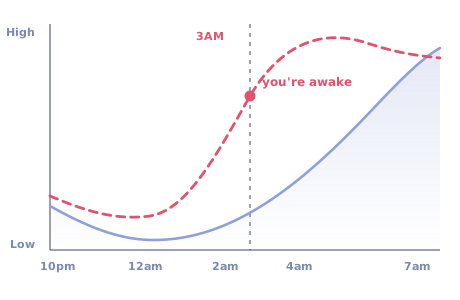
On schedule
Dehydrated
Illustrative shape of a nightly rhythm. Not measured values, and not a depiction of any individual.
And the loop pays for itself
✕
Your brain flushes waste during deep sleep — and that system runs on fluid. Dehydrated, it works at half speed
✕
So you wake up more tired than when you went to bed, which makes no sense until you know why
✕
You reach for coffee. Coffee raises cortisol. The second and third ones push it later into the day
✕
Which means you go to bed with it still elevated — and even further behind on fluid
✕
So three o'clock comes round again, slightly earlier, and the whole thing restarts
The mechanism
Cortisol clocks in at three. Here's who called it.
Cortisol isn't a poison. It's an alarm.
It's the hormone that gets you upright in the morning — it's supposed to bottom out around midnight and climb slowly towards seven, so that by the time the alarm goes your body has already started the engine. That's its job, and when it runs on schedule you never notice it.
Alarms don't go off for no reason, though. Something has to trip it. And the thing tripping it at one in the morning is not your job, your stress levels, or anything you did that day.
You go to bed dehydrated. Your body reads that as a threat. A threat means cortisol.
Across a single night you lose close to a litre of water — just breathing and sweating, continuously, for eight hours, while taking absolutely nothing in. If you started the night even slightly behind, you finish it badly behind.
And your nervous system doesn't experience fluid loss the way you do. You feel thirst. It registers a system running short — and a system running short is a danger signal. So it does the one thing it's built to do with a danger signal.
It sends for cortisol. Hours early.
Which is why it's always three
The curve should be at its lowest around midnight. Dehydrated and stressed, it starts climbing from about one instead. By three it's high enough to pull you straight out of sleep — heart going, brain running, no idea why.
You weren't woken by a noise or a worry. You were woken on purpose, by your own body, for a reason it thought was good.
On schedule
Dehydrated
Illustrative shape of a nightly rhythm. Not measured values, and not a depiction of any individual.
And the loop pays for itself
✕
Your brain flushes waste during deep sleep — and that system runs on fluid. Dehydrated, it works at half speed
✕
So you wake up more tired than when you went to bed, which makes no sense until you know why
✕
You reach for coffee. Coffee raises cortisol. The second and third ones push it later into the day
✕
Which means you go to bed with it still elevated — and even further behind on fluid
✕
So three o'clock comes round again, slightly earlier, and the whole thing restarts
Why everything in that drawer failed — and it's the same reason every time.
Go and look at what's in there. Melatonin. A tub of magnesium. Something herbal you bought in an airport. Maybe an antihistamine on the bad weeks. Possibly a gummy.

Different molecules, different prices, different promises on the front of each box. And every single one of them is doing the same job.
They all work on your brain. Not one of them works on the thing that's waking it up.
That's the shared flaw, and it's why the pattern is always identical: something helps a bit for a fortnight, then quietly stops, and you move on to the next thing with the bottle two-thirds full.
Melatonin gets you unconscious faster. That's the whole of it. It has no effect on cortisol and no effect on the dehydration driving it — which is exactly why you still wake at three, and why you still feel terrible at seven. It just means you were asleep for slightly longer first.
A magnesium tablet does one job, reasonably well. One. The night asks for more than one.
Antihistamines are sedation with a tax attached, and the tax is collected at 6am.
Sleep hygiene — the cold room, the dark, the screens — improves the conditions you sleep in. It does not put a single thing back into a body that's been emptying out for eight hours. You can have a perfect bedroom and still be woken by your own biochemistry.
And the one that comes closest
A big glass of water before bed. The instinct is exactly right, and it backfires — which is why almost everyone has tried it and given up.
Plain water passes straight through you. With nothing in it to hold it in circulation, most of it is at your bladder within the hour. So you get up at two and you're still dehydrated by three. Most people conclude that drinking before bed doesn't work.
What doesn't work is drinking that.
You didn't fail at any of this. You were aiming at the brain when the problem was in the tank.
Why everything in that drawer failed — and it's the same reason every time.
Go and look at what's in there. Melatonin. A tub of magnesium. Something herbal you bought in an airport. Maybe an antihistamine on the bad weeks. Possibly a gummy.
Different molecules, different prices, different promises on the front of each box. And every single one of them is doing the same job.
They all work on your brain. Not one of them works on the thing that's waking it up.
That's the shared flaw, and it's why the pattern is always identical: something helps a bit for a fortnight, then quietly stops, and you move on to the next thing with the bottle two-thirds full.
Melatonin gets you unconscious faster. That's the whole of it. It has no effect on cortisol and no effect on the dehydration driving it — which is exactly why you still wake at three, and why you still feel terrible at seven. It just means you were asleep for slightly longer first.
A magnesium tablet does one job, reasonably well. One. The night asks for more than one.
Antihistamines are sedation with a tax attached, and the tax is collected at 6am.
Sleep hygiene — the cold room, the dark, the screens — improves the conditions you sleep in. It does not put a single thing back into a body that's been emptying out for eight hours. You can have a perfect bedroom and still be woken by your own biochemistry.
And the one that comes closest
A big glass of water before bed. The instinct is exactly right, and it backfires — which is why almost everyone has tried it and given up.
Plain water passes straight through you. With nothing in it to hold it in circulation, most of it is at your bladder within the hour. So you get up at two and you're still dehydrated by three. Most people conclude that drinking before bed doesn't work.
What doesn't work is drinking that.
You didn't fail at any of this. You were aiming at the brain when the problem was in the tank.
Why another month costs you
The loop tightens. It doesn't hold still.
Nobody decides to become a four-coffee person. It happens across about eighteen months, one entirely reasonable decision at a time.
You wake at seventy percent, so you have one. It works. By eleven you need the second because there's something you actually have to concentrate on. By two you're flat again, so there's a third — and that one is close enough to the evening to still be circulating at bedtime, raising the hormone you're trying to lower, on top of a body that's already short on fluid.
Tomorrow starts a little lower than today did.
✕
The caffeine curfew creeps later, degrading the sleep it's compensating for
✕
The first useful hour of the day drifts from nine, to ten, to whenever the second coffee lands
✕
Training moves to the evening because mornings are unusable, which pushes bedtime later again
✕
And eventually you stop calling it a problem and start calling it your age
That last one is the real cost. Not the sleep — the moment you file it under getting older and stop looking for a cause.
Why another month costs you
The loop tightens. It doesn't hold still.
Nobody decides to become a four-coffee person. It happens across about eighteen months, one entirely reasonable decision at a time.
You wake at seventy percent, so you have one. It works. By eleven you need the second because there's something you actually have to concentrate on. By two you're flat again, so there's a third — and that one is close enough to the evening to still be circulating at bedtime, raising the hormone you're trying to lower, on top of a body that's already short on fluid.
Tomorrow starts a little lower than today did.
✕
The caffeine curfew creeps later, degrading the sleep it's compensating for
✕
The first useful hour of the day drifts from nine, to ten, to whenever the second coffee lands
✕
Training moves to the evening because mornings are unusable, which pushes bedtime later again
✕
And eventually you stop calling it a problem and start calling it your age
That last one is the real cost. Not the sleep — the moment you file it under getting older and stop looking for a cause.
The variable nobody sells
Overnight Mineral Loading
If the alarm is being tripped by dehydration, there are only two ways to stop it. Drink during the night — which you can't, because you're unconscious. Or go into the night with enough in the tank that the signal never fires.
That's the entire idea, and it only works if the fluid stays.
Plain water doesn't stay. Without the minerals that hold it in circulation, you've simply moved the problem to your bladder. But water carrying sodium, potassium and magnesium in the right ratio at the right dose behaves completely differently — it's retained across the whole window instead of flushed before it.
Your body holds its water. So it never sends for cortisol. So three o'clock comes and goes.

Endurance athletes have understood the principle for decades — you don't hydrate during the event, you load before it, because there's a limit to what you can take on mid-race. A night is the same problem: eight hours of continuous loss you cannot interrupt.
The sleep aisle has never thought of itself as having anything to do with hydration. The hydration aisle doses everything for a session in the gym at two in the afternoon. Nobody was formulating for the eight hours in between.
~1L
Fluid lost across a single night, breathing and sweating alone
8 hrs
Of continuous loss with zero intake
60 min
The only window where you can do anything about it
The variable nobody sells
Overnight Mineral Loading
If the alarm is being tripped by dehydration, there are only two ways to stop it. Drink during the night — which you can't, because you're unconscious. Or go into the night with enough in the tank that the signal never fires.
That's the entire idea, and it only works if the fluid stays.
Plain water doesn't stay. Without the minerals that hold it in circulation, you've simply moved the problem to your bladder. But water carrying sodium, potassium and magnesium in the right ratio at the right dose behaves completely differently — it's retained across the whole window instead of flushed before it.
Your body holds its water. So it never sends for cortisol. So three o'clock comes and goes.
Endurance athletes have understood the principle for decades — you don't hydrate during the event, you load before it, because there's a limit to what you can take on mid-race. A night is the same problem: eight hours of continuous loss you cannot interrupt.
The sleep aisle has never thought of itself as having anything to do with hydration. The hydration aisle doses everything for a session in the gym at two in the afternoon. Nobody was formulating for the eight hours in between.
~1L
Fluid lost across a single night, breathing and sweating alone
8 hrs
Of continuous loss with zero intake
60 min
The only window where you can do anything about it
The Study Behind Hydration, Cortisol & Stress
The Study Behind Hydration, Cortisol & Stress
Built on it
Cadence Sleep Hydration
A tart cherry drink mix. One sachet in a small glass of water, an hour before bed. Deliberately the least interesting thing in your evening — and the first one aimed at the hour that wakes you rather than the ten minutes before you fall asleep.
Built on it
Cadence Sleep Hydration
A tart cherry drink mix. One sachet in a small glass of water, an hour before bed. Deliberately the least interesting thing in your evening — and the first one aimed at the hour that wakes you rather than the ten minutes before you fall asleep.
Three jobs the drawer never did together.
Pillar 01 · Remove the trigger
Hold the water through the night
100mg sodium, 100mg potassium, 50mg marine magnesium. A fraction of a training dose on purpose — load this like a sports drink and you'll be up at two for a different reason.
It's the smallest amount that keeps fluid in circulation across the whole window rather than passing through before it. No deficit, no danger signal, no reason for cortisol to clock in early.
Pillar 02 · Get in, and stay in
Drop your core temperature
1000mg of L-glycine. A full gram, not a gesture. Glycine lowers core body temperature, which is one of your body's own switches for deep sleep — not a sedative effect, the actual signal.
That matters for three o'clock specifically. Deeper sleep is harder to be pulled out of, and it's also when the brain's overnight clean-up runs at full speed.
Pillar 03 · Two timescales at once
Calm the response tonight, and in a month
200mg L-theanine turns the volume down in the evening — it works the same night you take it. 100mg ashwagandha works the other way: it builds in your system across weeks and holds the stress response lower all day, not only at bedtime.
Plus 75mg valerian root at a concentrated 10:1 extract. That's the difference between week one and week four.
And no melatonin. On purpose.
1000mg of L-tryptophan with 14mg of B6 gives your body what it needs to make its own melatonin, on its own schedule. Not a synthetic dose delivered at a time your body didn't choose — which is where the vivid dreams and the seven o'clock fog come from.
Three jobs the drawer never did together.
Pillar 01 · Remove the trigger
Hold the water through the night
100mg sodium, 100mg potassium, 50mg marine magnesium. A fraction of a training dose on purpose — load this like a sports drink and you'll be up at two for a different reason.
It's the smallest amount that keeps fluid in circulation across the whole window rather than passing through before it. No deficit, no danger signal, no reason for cortisol to clock in early.
Pillar 02 · Get in, and stay in
Drop your core temperature
1000mg of L-glycine. A full gram, not a gesture. Glycine lowers core body temperature, which is one of your body's own switches for deep sleep — not a sedative effect, the actual signal.
That matters for three o'clock specifically. Deeper sleep is harder to be pulled out of, and it's also when the brain's overnight clean-up runs at full speed.
Pillar 03 · Two timescales at once
Calm the response tonight, and in a month
200mg L-theanine turns the volume down in the evening — it works the same night you take it. 100mg ashwagandha works the other way: it builds in your system across weeks and holds the stress response lower all day, not only at bedtime.
Plus 75mg valerian root at a concentrated 10:1 extract. That's the difference between week one and week four.
And no melatonin. On purpose.
1000mg of L-tryptophan with 14mg of B6 gives your body what it needs to make its own melatonin, on its own schedule. Not a synthetic dose delivered at a time your body didn't choose — which is where the vivid dreams and the seven o'clock fog come from.
What happens, week by week.
Honestly, including the week where nothing much does.
Week 1
Asleep without the fight
The electrolytes go to work on the overnight deficit immediately. Falling asleep stops being a negotiation. The night itself hasn't changed yet.
Week 2
Three o'clock comes and goes
Glycine has dropped your core temperature, so you're deep enough to sleep through the hour that used to pull you out. The daytime fog starts lifting.
Week 3
Awake just before the alarm
Ashwagandha has built up. The stress response stays lower across the whole day — the afternoon collapse goes with it.
Week 4
A month of deep sleep behind you
No naps. No third coffee. Someone asks what you've changed.
Permission on file for every capture used. Individual results vary.
What happens, week by week.
Honestly, including the week where nothing much does.
Week 1
Asleep without the fight
The electrolytes go to work on the overnight deficit immediately. Falling asleep stops being a negotiation. The night itself hasn't changed yet.
Week 2
Three o'clock comes and goes
Glycine has dropped your core temperature, so you're deep enough to sleep through the hour that used to pull you out. The daytime fog starts lifting.
Week 3
Awake just before the alarm
Ashwagandha has built up. The stress response stays lower across the whole day — the afternoon collapse goes with it.
Week 4
A month of deep sleep behind you
No naps. No third coffee. Someone asks what you've changed.
Permission on file for every capture used. Individual results vary.
Forty seconds. Then you go to bed.
You've abandoned a routine before — everyone with that drawer has. So here's exactly what it costs, in seconds, before you commit to anything.
01
Tear it into a small glass of water
300 to 350ml, not a pint. Tart cherry. Cold, or warm like a tea if you'd rather.
02
Drink it an hour before bed
An hour, not five minutes. The point is to be loaded before the window opens, not drinking as it does.
03
Put the other bottles away
This replaces three or four of them. Run them all at once and you'll never know what moved.
Everything, in one place
★★★★★ 4.7 from 2,400+ verified reviews
Holds your water overnight so the threat signal never fires — 100mg sodium, 100mg potassium, 50mg marine magnesium
1000mg glycine drops your core temperature into deep sleep
Theanine tonight, ashwagandha across the weeks — two timescales in one glass
Builds your own melatonin from tryptophan and B6 — no gummies, no vivid dreams, no morning fog
Every milligram printed on the pack. No proprietary blends
Informed Sport certified, GMP manufactured, third-party tested every batch
60 nights to judge it. Use all thirty sachets and still get your money back


Free cap included · Cancel any time · 60-night guarantee
Forty seconds. Then you go to bed.
You've abandoned a routine before — everyone with that drawer has. So here's exactly what it costs, in seconds, before you commit to anything.
01
Tear it into a small glass of water
300 to 350ml, not a pint. Tart cherry. Cold, or warm like a tea if you'd rather.
02
Drink it an hour before bed
An hour, not five minutes. The point is to be loaded before the window opens, not drinking as it does.
03
Put the other bottles away
This replaces three or four of them. Run them all at once and you'll never know what moved.
Everything, in one place
★★★★★ 4.7 from 2,400+ verified reviews
Holds your water overnight so the threat signal never fires — 100mg sodium, 100mg potassium, 50mg marine magnesium
1000mg glycine drops your core temperature into deep sleep
Theanine tonight, ashwagandha across the weeks — two timescales in one glass
Builds your own melatonin from tryptophan and B6 — no gummies, no vivid dreams, no morning fog
Every milligram printed on the pack. No proprietary blends
Informed Sport certified, GMP manufactured, third-party tested every batch
60 nights to judge it. Use all thirty sachets and still get your money back
Free cap included · Cancel any time · 60-night guarantee
You don't have to decide tonight
Sixty nights. Empty box still counts.
The full effect builds across about four weeks, so we made the window twice that. There is no version of a fair test that runs out of time — and a thirty-day guarantee quietly cuts people off exactly when it starts working.
Use all thirty sachets. If three o'clock is exactly where it was, email us and we'll refund it. No return shipping, no form, nobody asking you to justify it.
We can write that because of what happens at week four. The people who get that far don't ask for refunds — and the handful who do have told us something worth knowing.
You don't have to decide tonight
Sixty nights. Empty box still counts.
The full effect builds across about four weeks, so we made the window twice that. There is no version of a fair test that runs out of time — and a thirty-day guarantee quietly cuts people off exactly when it starts working.
Use all thirty sachets. If three o'clock is exactly where it was, email us and we'll refund it. No return shipping, no form, nobody asking you to justify it.
We can write that because of what happens at week four. The people who get that far don't ask for refunds — and the handful who do have told us something worth knowing.
Food supplement. Not a substitute for a varied, balanced diet or a healthy lifestyle. Not intended to diagnose, treat, cure or prevent any disease. Individual results vary.
Overnight fluid loss figures describe a healthy adult average and vary considerably with room temperature, bedding, body size and individual physiology. If night waking has persisted for months — and particularly if you snore heavily or have been told you stop breathing in your sleep — speak to your GP. That can indicate sleep apnea, and no supplement substitutes for ruling it out.
Food supplement. Not a substitute for a varied, balanced diet or a healthy lifestyle. Not intended to diagnose, treat, cure or prevent any disease. Individual results vary.
Overnight fluid loss figures describe a healthy adult average and vary considerably with room temperature, bedding, body size and individual physiology. If night waking has persisted for months — and particularly if you snore heavily or have been told you stop breathing in your sleep — speak to your GP. That can indicate sleep apnea, and no supplement substitutes for ruling it out.